Previous
Next

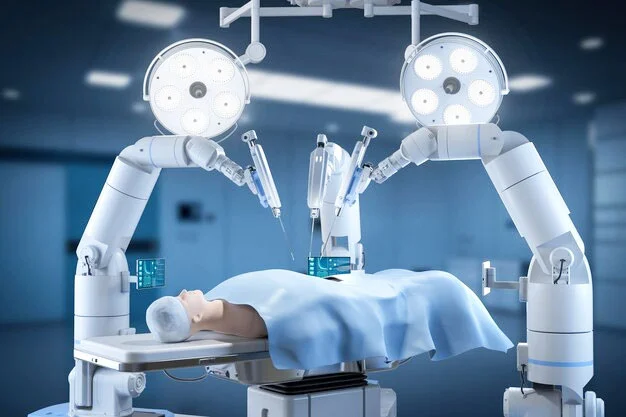
You have just been told that you need surgery, and while searching for your options, you keep seeing the phrase “robotic surgery.”
It sounds impressive. But then another thought comes up: “Is robotic surgery actually better for me, or am I paying more simply because the technology is newer?”
That is a sensible concern.
Robotic-assisted surgery can offer useful advantages in selected procedures, particularly when the surgeon needs precise movements or better access to difficult areas. But it is not a replacement for surgical skill, and not every patient needs it.
Robotic surgery is a form of minimally invasive surgery where the surgeon controls specialized instruments using a robotic surgical system.
The robot does not decide what to cut, stitch, or remove. The surgeon controls the instruments throughout the procedure.
The system may provide a magnified three-dimensional view and instruments that can make controlled movements in areas where conventional instruments can be harder to maneuver.
For some complex operations, that can be genuinely useful.
The technology tends to be most valuable when an operation requires precision or involves a difficult anatomical area.
Not every hernia requires robotic surgery.
However, recurrent hernias, larger abdominal wall defects, or cases involving previous repairs can be technically challenging. In selected patients, robotic assistance may help the surgeon work through a minimally invasive approach.
Some operations involving the stomach or bowel require careful dissection and suturing around delicate structures.
Robotic instruments can provide additional wrist-like movement, which may be useful during technically demanding procedures.
Some parts of the body are difficult to access with straight laparoscopic instruments.
The flexibility of robotic instruments can give the surgeon more control in certain confined spaces.
But whether this advantage translates into a meaningful benefit for the patient depends on the actual procedure.
This is perhaps the most important thing patients should understand.
Robotic surgery is surgeon-controlled surgery.
If you are looking for the Robotic Surgery Expert in Faridabad Sector 20, don't simply ask whether the surgeon has access to a robotic system.
Ask how much experience they have with robotic surgery and, more importantly, how much experience they have with your particular operation.
A sophisticated machine in inexperienced hands does not automatically produce better surgery.
Many patients assume that if robotic surgery costs more, it must automatically be better.
That's not necessarily true.
For some straightforward operations, conventional laparoscopy may provide an excellent result without the additional complexity or cost of robotic assistance.
The better question is not, “Is robotic surgery more advanced?”
Ask: “What specific advantage does robotic surgery offer in my case?”
If the answer is clear and clinically meaningful, the technology may be worth considering. If there is no clear advantage, another approach may be perfectly reasonable.
Consider a patient who has already had a hernia repair but develops another hernia in the same area.
The surgeon reviews the previous operation, examines the abdominal wall, and studies the relevant imaging. Because this is a recurrent problem, the anatomy may be more challenging than during the first operation.
In such a case, robotic assistance may be considered if it allows the surgeon to work more precisely through a minimally invasive approach.
The important part is not the robot itself. The technology is being matched to the complexity of the patient's problem.
Robotic surgery has expanded significantly in recent years.
In 2024, Intuitive Surgical reported that its installed base of da Vinci surgical systems worldwide had crossed 10,000 systems, reflecting the growing global adoption of robotic-assisted surgery.
That growth is significant, but adoption does not mean robotic surgery is required for every patient.
Technology creates additional surgical options. It does not remove the need for clinical judgment.
If you are evaluating the Robotic Surgery Expert in Faridabad Sector 20, focus on practical questions rather than impressive terminology.
A surgeon's total number of robotic operations can be less useful than their experience with the exact procedure you need.
Ask how frequently they perform it and whether robotic surgery is their routine approach for similar cases.
Find out whether laparoscopic or open surgery could also provide a good result.
You should understand the advantages and disadvantages of each approach before making a decision.
No operation is risk-free.
Your surgeon should explain possible complications, expected recovery, and what happens if the procedure cannot safely be completed robotically.
A plan for unexpected situations is a sign of good surgical preparation—not a reason for fear.
Before surgery, your medical team will review your symptoms, diagnosis, medications, previous operations, and general health.
You may need blood tests, imaging, or other medical evaluations depending on the procedure.
Your surgeon should also explain the operation step by step and provide instructions about fasting, medications, and preparation.
Use this appointment to ask every question you have.
Robotic surgery is usually performed through small incisions, so many patients may experience the typical benefits associated with minimally invasive surgery.
However, recovery is not determined by the robot.
The type and complexity of the operation, your health, age, activity level, and any complications all influence recovery.
Some patients return to routine activities relatively quickly, while others need several weeks.
Dr. Birbal Kumar is associated with laparoscopic and bariatric surgical care and has experience in minimally invasive surgical procedures. His work highlights an important principle for patients considering advanced surgical techniques: technology should be selected based on the patient's diagnosis and surgical requirements, while experience, careful planning and postoperative care remain central to treatment.
Take these questions to your consultation:
Why do I need surgery?
Why are you recommending robotic surgery?
What advantage does it offer in my case?
Could laparoscopy or open surgery work just as well?
How often do you perform this specific robotic procedure?
What are the possible complications?
How long will recovery take?
What happens if robotic surgery cannot be completed as planned?
What will the total treatment cost include?
You don't need to understand every technical detail. You simply need enough information to make an informed decision.
You may benefit from a specialist consultation if another doctor has recommended abdominal surgery, you have a complicated or recurrent hernia, or you want to understand whether robotic assistance could be useful for your condition.
A second opinion can also be valuable when the recommended procedure is complex or you are uncertain about the available options.
Not necessarily. Robotic surgery may provide technical advantages during certain complex procedures, while conventional laparoscopy can be highly effective for many operations. The best approach depends on the patient and procedure.
Robotic-assisted surgery can be performed safely in appropriate patients by trained surgical teams. However, it still involves the risks associated with surgery, and your surgeon should explain these before treatment.
Robotic surgery is minimally invasive, which may support recovery in suitable procedures. However, recovery time depends primarily on the operation, your health, and whether complications occur.
Robotic surgery is an impressive tool, but a tool is only as useful as the person using it and the problem it is being used to solve.
Don't choose robotic surgery because it sounds more advanced or because someone promises a quicker recovery.
Choose it when your surgeon can clearly explain why it offers a meaningful advantage for your specific condition.
The Robotic Surgery Expert in Faridabad Sector 20 should be someone who understands both the possibilities and limitations of robotic technology—and is willing to recommend another approach when it is better for the patient.
If you have been advised to undergo complex surgery and want to know whether robotic assistance could benefit you, schedule a consultation to discuss your diagnosis, surgical options, expected results, risks, and recovery.