
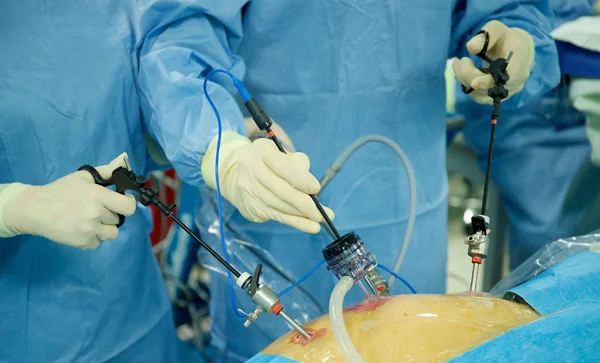
Laparoscopic and Robotic Hernia Repair in Faridabad is a modern surgical technique used to treat hernia safely and effectively with minimal pain and faster recovery. A hernia occurs when an internal organ or tissue pushes through a weak spot in the abdominal wall, causing a visible bulge and discomfort. It commonly appears in the abdomen, groin, or near previous surgical scars.
Hernias do not heal on their own and often require surgical correction. With advancements in medical science, minimally invasive laparoscopic and robotic techniques have replaced traditional open surgery in most cases. These advanced procedures use small incisions, a camera system, and high-precision instruments to repair the hernia with excellent accuracy.
At Dr. Birbal Kumar’s clinic in Faridabad, Laparoscopic and Robotic Hernia Repair is performed using state-of-the-art technology to ensure safe outcomes, reduced pain, minimal scarring, and faster recovery. Patients benefit from a quicker return to normal activities and lower chances of recurrence.
A hernia occurs when an internal organ, usually part of the intestine or fatty tissue, pushes through a weak area in the muscle or connective tissue of the abdominal wall.
Common types of hernia include:
Common causes include:
Patients may experience:
If symptoms persist, Laparoscopic and Robotic Hernia Repair in Faridabad may be required.
Hernia surgery is recommended when:
Early surgery helps prevent complications.
A minimally invasive technique using small incisions, a camera, and mesh placement to repair the weakened abdominal wall.
An advanced technique where robotic arms assist the surgeon, providing enhanced precision, flexibility, and better control during complex repairs.
Both methods aim to strengthen the abdominal wall and reduce recurrence risk.
Small incisions instead of large open cuts.
Significantly reduced postoperative discomfort.
Most patients return to normal life within a few days.
Better cosmetic outcomes compared to open surgery.
Mesh-based repair provides long-term strength.
Robotic systems improve accuracy in complex cases.
Dr. Birbal Kumar performs a physical examination and imaging tests such as ultrasound or CT scan.
General anesthesia is given for a painless procedure.
For laparoscopic surgery, 3–4 small incisions are made. Robotic systems may assist through similar ports.
The protruding tissue is repositioned, and a surgical mesh is placed to strengthen the abdominal wall.
Incisions are closed with minimal sutures or surgical glue.
Recovery is generally smooth and quick.
Patients may experience:
Recovery care includes:
Most patients recover within 7–10 days.
To ensure proper healing and prevent recurrence:
Consult Dr. Birbal Kumar if you experience:
Early treatment prevents serious complications like strangulation.
Patients trust Dr. Birbal Kumar for:
Laparoscopic and Robotic Hernia Repair in Faridabad is a safe, advanced, and highly effective treatment for all types of hernias. It offers minimal pain, faster recovery, and excellent long-term outcomes compared to traditional open surgery.
With expert care from Dr. Birbal Kumar and modern surgical technology, patients can safely treat hernia conditions and return to normal life quickly and confidently.
Yes, laparoscopic and robotic hernia repairs are very safe and commonly performed procedures.
Most patients recover within 7–10 days.
Recurrence is low if proper mesh repair and precautions are followed.
Both are effective; robotic surgery offers higher precision in complex cases.
Usually 1–2 days depending on the patient’s condition.



Write a Reply or Comment