Previous
Next

Myths vs. Facts: Laser Treatment of Fistula in ano
Myth: It’s experimental or unsafe.
⇒ Fact: It’s a well-established, FDA-approved, and widely used technique, often safer than traditional surgery due to minimal tissue damage.
Myth: It’s extremely painful.
⇒ Fact: Patients report minimal pain and discomfort because it avoids large cuts, with most feeling only mild soreness.
Myth: It can’t treat complex or critical fistulas.
⇒ Fact: Laser therapy is very effective for complex fistulas, precisely targeting the tract while preserving the anal sphincter, reducing incontinence risk.
Myth: Recovery is long (weeks/months).
⇒ Fact: It’s a daycare procedure, allowing patients to return to normal activities in 24-48 hours, unlike traditional surgery.
Myth: It’s a guaranteed, permanent cure.
⇒ Fact: While highly effective, success depends on the surgeon’s skill, and some recurrence risk exists (though lower than traditional methods), requiring proper care.
Myth: It’s only for simple cases or a last resort.
⇒ Fact: It’s a great option for many types, including complex ones, offering benefits over older methods like fistulotomy/fistulectomy.
Myth: It’s too expensive.
⇒ Fact: Costs are becoming competitive, and it can be more affordable than traditional surgery when considering lost work time and complications
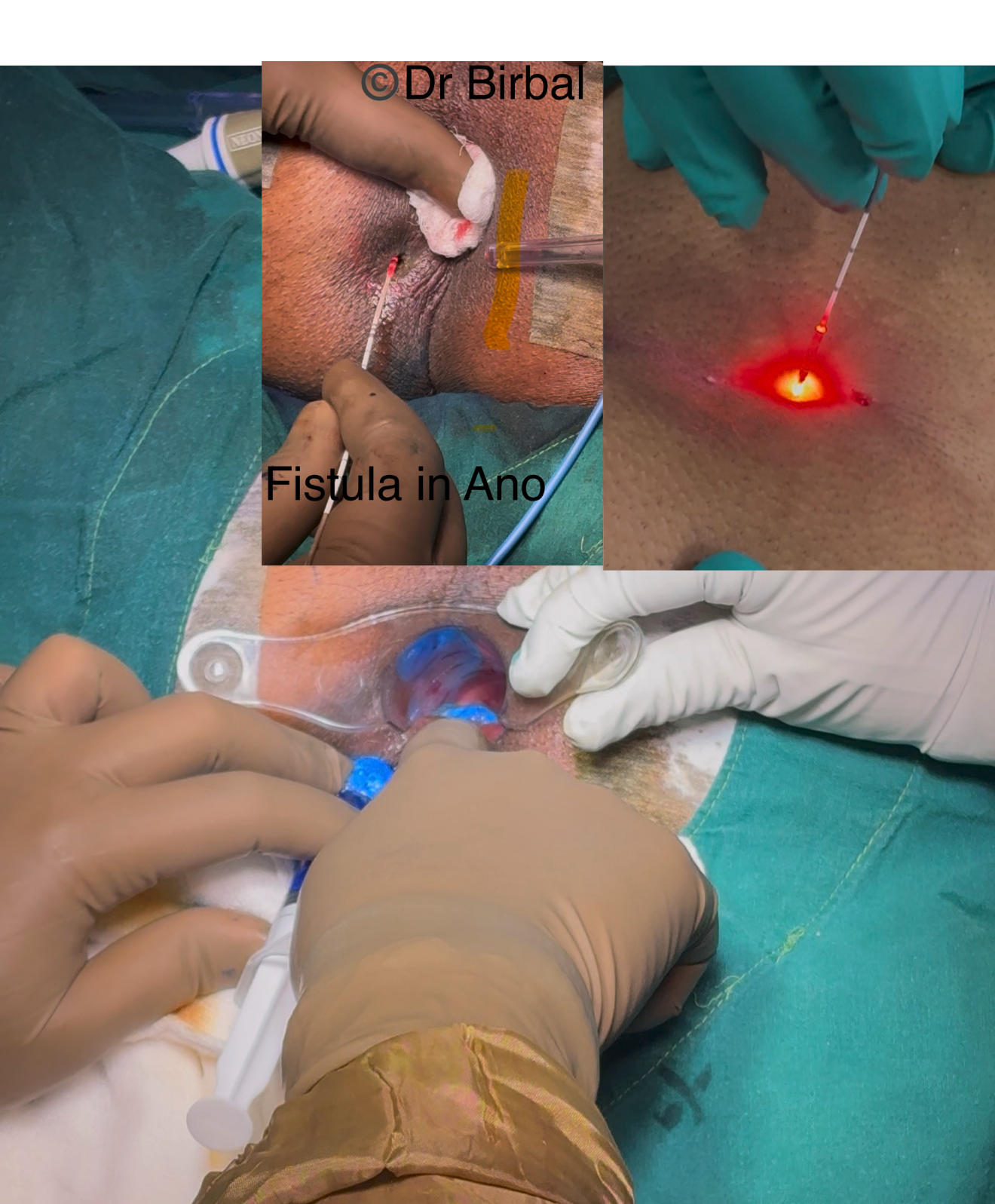 Fistula Laser Closing’ (FiLaC) (Biolitec AG, Jena, Germany)
⇒ Minimal invasive technique utilizes laser energy to carry out the process for fistula tract ablation.
⇒ A radial fiber emits laser beam into the fistula track causing the tissue to shrink, thus helping in the sealing process.
⇒ The closure of the internal opening is achieved by an endorectal flap.
Park’s classification Fistula in ano ;
Intersphincteric fistula (IF)
Transsphincteric fistula (TF)
Suprasphincteric fistula (SF)
Extrasphincteric fistulas(EF)
Key Outcomes related to Laser fistula in ano;
⇒ Success Rates: Primary healing rates more than 80%.
⇒ Pain & Recovery: Significantly less pain and quicker return to work within a week.
⇒ Incontinence: minimal
⇒ Recurrence: Occurs in some cases (around 18-20%), but secondary procedures can improve outcomes.
⇒ Complications: Generally minimal, with low rates of infection or abscesses
Factors Influencing Outcomes:
⇒ Fistula Type: More suitable for simple fistulas, though effective in complex ones too.
⇒ Hygiene: Crucial for preventing infection and recurrence.
⇒ Patient Compliance: Following post-op instructions boosts success.